
Why Your A/C Freezes Up on the Hottest Day of Summer
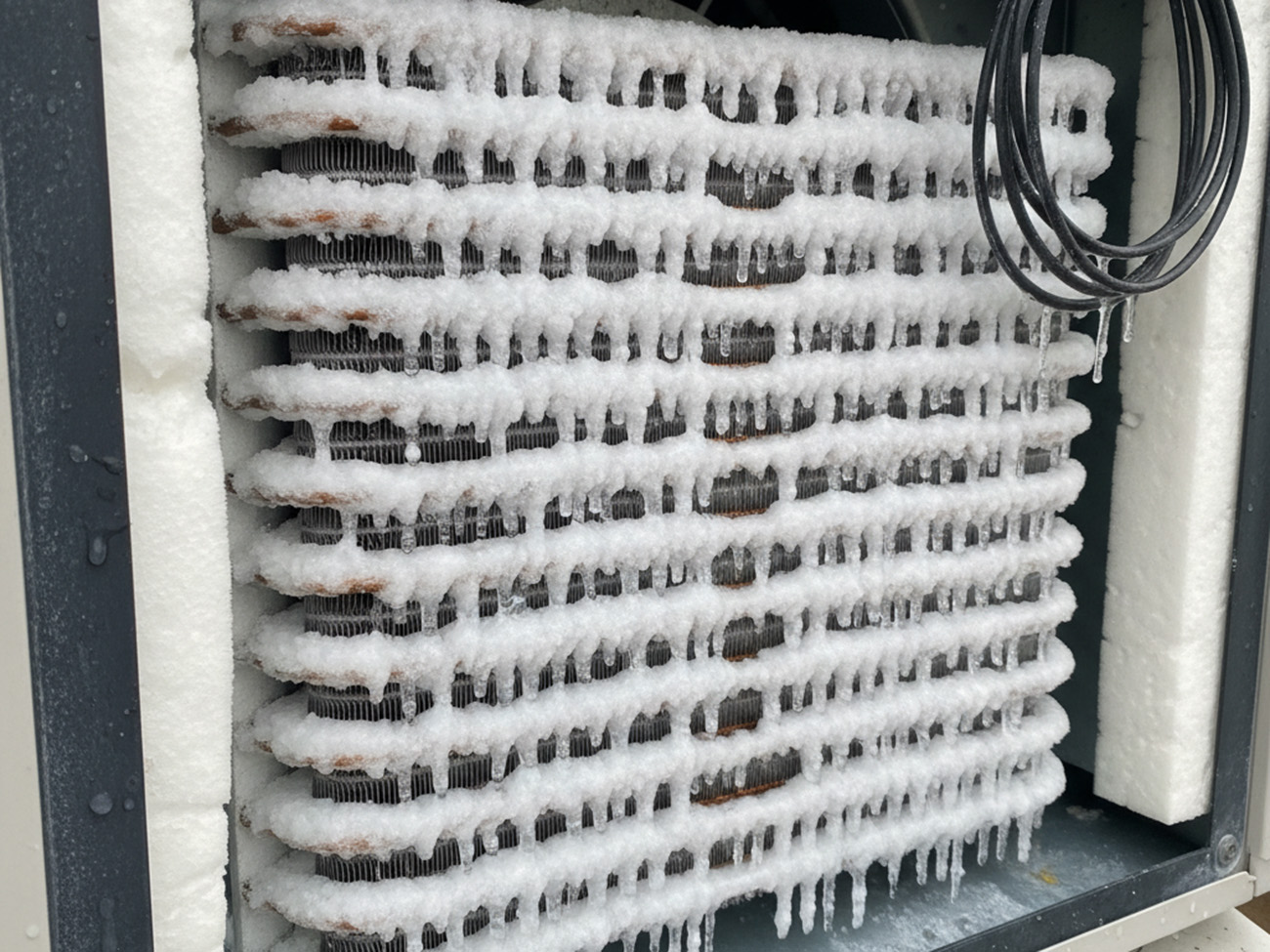
It was 34 degrees in Mississauga, the kind of July afternoon where the air feels thick enough to chew. We pulled up to a two-storey on a cul-de-sac and the homeowner met me at the door, frustrated. “It was working fine yesterday. Now it’s blowing warm air and there’s ice all over the thing outside.”
Ice. In July. On an air conditioner.
We see this every single summer, usually on the hottest week of the year, because that’s when systems are working the hardest and every weakness shows up at once. And almost every homeowner’s first instinct — crank the thermostat even lower to “force” it — makes it worse.
Freezing means something is wrong, not that it’s working extra hard
Here’s the thing most people don’t realize: your air conditioner doesn’t make cold air. It moves heat out of your house. Warm indoor air blows across a cold evaporator coil, the refrigerant inside absorbs that heat, and the cycle repeats.
When ice forms on the coil or the copper lines, it means heat isn’t reaching the refrigerant the way it should. The coil gets colder and colder until condensation on it freezes solid. And once it’s a block of ice, airflow drops to almost nothing, which makes it freeze even harder. It’s a spiral, and it always ends with warm air coming out of your vents on the day you need cold air most.
The two culprits behind 90% of freeze-ups
1. Restricted airflow — usually a dirty filter. This is the number one cause we find, and it’s the cheapest fix in all of HVAC. A clogged filter chokes the air moving across the coil. Less warm air reaching the coil means the coil temperature drops below freezing, and the moisture in the air turns to ice instead of draining away.
We’ve pulled filters out of furnaces that looked like grey felt blankets. The homeowner always says the same thing: “I kept meaning to change it.” A $15 filter, changed every one to three months in cooling season, prevents a $200 service call. Every time.
2. Low refrigerant from a leak. Refrigerant doesn’t get “used up” — it’s a sealed system. If the charge is low, there’s a leak somewhere, full stop. Low refrigerant means low pressure, and low pressure means the coil runs colder than designed. Ice city.
This one needs a licensed tech, because finding and fixing a leak properly takes equipment and certification. And here’s what we tell every customer: if a company just “tops it up” without finding the leak, you’re renting cold air. You’ll be paying for another top-up next summer, and the summer after that, until the compressor dies from running starved. Fix the leak once.
Less common causes we run into: a filthy evaporator coil (years without cleaning), a failing blower motor moving too little air, or supply vents closed off in too many rooms — yes, closing vents to “push air where you want it” can actually freeze your system. Your ductwork was sized for a reason.
What to do right now if yours is frozen
- Turn the system completely OFF. Not up — off. Running it frozen can send liquid refrigerant back to the compressor, and compressors are built to pump gas, not liquid. That’s how a $200 visit becomes a $2,000 compressor replacement.
- Let it thaw fully. This can take several hours. Put towels around the indoor unit; there’s going to be water when that ice melts.
- Check your filter. If it’s dirty, replace it before you restart.
- Once thawed, try running just the fan for a while before switching cooling back on.
If it freezes up again within a day or two, stop and call someone. You’ve got a refrigerant or mechanical problem that no filter change will fix.
How to keep it from happening again
Honestly, it’s boring stuff: change the filter on schedule, keep at least 80% of your supply vents open, hose down the outdoor condenser coil gently each spring (kill the power first), and get a proper tune-up once a year before cooling season. A tech will check refrigerant charge, clean the coil, and catch the small stuff before it becomes a no-cooling emergency at 9 p.m. on a Saturday.
At First Choice Heating & Air Conditioning, we’re a TSSA-certified licensed HVAC contractor. Our certified gas technicians have been keeping GTA homes cool for years — and we can tell you the freeze-up calls are almost always preventable. The systems that get a little attention every spring are the ones still running strong in August.
Why Choose Us
We are leading HVAC company in GTA, specializing in the sales, installation, maintenance, and repairs of all HVAC units.